

Misericordia
Misericordia opens from the point of view of an unknown driver navigating winding roads of southern France until we finally arrive at Saint-Martial, the sort of European village that likely hasn’t changed in centuries. Who is the driver, and why has he arrived here? Writer-director Alain Guiraudie takes time answering these questions directly, but motives are not easily deciphered in this place.
Our motorist, Jérémie Pastor (Félix Kysyl), once lived in Saint-Martial and has returned for the funeral of his former mentor, the local baker. Jérémie, who had been in love with the newly deceased, finds comfort in being back, and he readily accepts an invitation from the man’s widow, Martine (Catherine Frot), to let him stay at her home. The reception from others is chillier. Martine’s hotheaded son, Vincent (Jean-Baptiste Durand), thinks Jérémie is out to diddle his mom. “He’s exploiting your loneliness!” Vincent tells the new widow, and the son’s suspicions grow when Jérémie begins wearing dead dad’s hand-me-downs.
While we don’t know if Jérémie wants to sleep with the older but indisputably attractive Martine, there are suggestions of an erotic past between him and Vincent. Serene salaciousness has a hold on Saint-Martial. The kindly parish priest, Abbé Philippe (Jacques Develay), doesn’t conceal his designs on boyish-looking Jérémie. Philippe forages for morels in nearby woodlands and proudly shows Jérémie the size of the mushrooms he has collected. And then there’s Vincent’s doughy friend, Walter (David Ayala), who is jobless, likes his drink and may harbor desires of his own.
Trying to tamp down so much horniness can only mean trouble. One thing leads to another, and someone dies. Revealing any more would spoil some of Misericordia’s surprises.
Screening May 16-18 at Oklahoma City Museum of Art, 415 Couch Drive, Misericordia has all the trappings of a sex farce, even if — despite some flashes of male nudity — there is a notable lack of sex. But the humor is bone-dry. Guiraudie, whose credits include 2013’s tonally similar Stranger by the Lake, weaves an atmosphere of sustained awkwardness. The vibe is quiet, contemplative and heightened by Claire Mathon’s exquisite cinematography of forests glistening with dew. The pastoral loveliness only underscores the absurdity of its characters’ not-so-dormant passions. (Grade: B)
Sinners
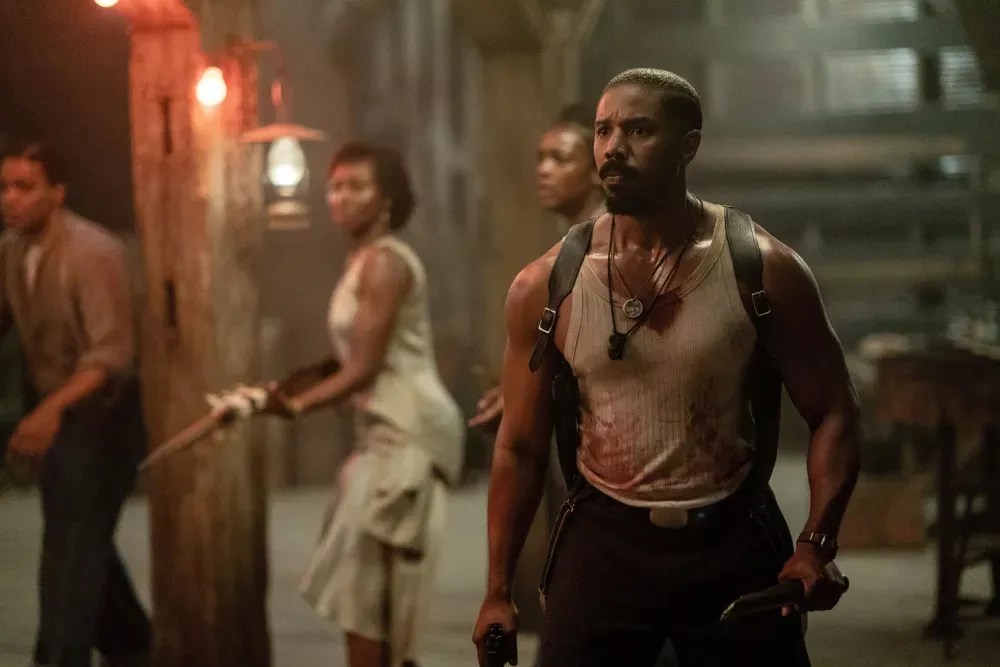
If Misericordia keeps its carnal appetites under wraps, Sinners eschews any such reservedness. Frank dialogue about sex (cunnilingus, if you must know) is only a sliver of what makes this spring blockbuster so much fun. Sexy, scary, exhilarating — there is simply a lot of everything in this bombastic genre mashup from Ryan Coogler, the writer-director’s first outing since helming Marvel’s Black Panther franchise.
Extricating oneself from other people’s IP can be freeing. You sense Coogler’s joy at being able to cut loose. Sinners is a lovingly detailed story of the Black experience in the Mississippi Delta of the 1930s. It is a vampire flick awash in bloodletting and garlic. It is a celebration of the timelessness of music — blues, to be precise — with a tasty helping of Irish folk tossed in for good measure.
In other words, Sinners does not lack for thematic content. In fact, one might argue that it could have benefited from less thematic content. Then again, one could argue that arguing over a movie this wildly entertaining is a buzzkill. Sinners is hardly perfect, but its flaws are outweighed by its zeal for cinema.
Set in Clarksdale, Mississippi, the film plops us into a vibrant Black community at the height of Depression-era Jim Crow. Identical twins Smoke and Stack (Michael B. Jordan pulling double duty) have returned home after a stint working in Chicago. Now flush with mob money and stolen booze, the brothers are converting an old sawmill into a juke joint where Delta sharecroppers can dance, drink and blow off steam.
A juke joint requires music. Stack rounds up his young cousin, Sammie Moore (Miles Caton), a bluesman whose musical aspirations are at odds with his disapproving preacher father. Sammie is joined by Delta Slim (always great Delroy Lindo), a seasoned harmonicist and piano player with a liking for corn liquor. While Stack is putting together the entertainment, Smoke is across town, rekindling things with Annie (Wunmi Mosaku), his wife and mother of their dead child.
That’s a lotta characters, and I haven’t even gotten to Stack’s love interest (Hailee Steinfeld) or the Asian married couple (Yao and Li Jun Li) who operate the local grocery. It is a testament to Coogler’s directorial chops that the film’s first third so thoroughly acclimates us to a distinct place and time, along with vivid characters we get to know through compactly delivered backstories. For all the visceral pizzazz we get once the sun goes down and the juke joint opens its doors, Sinners excels as period drama. The ensemble cast is exceptional. While Jordan has arguably the most challenging role (er, roles), he is nearly matched by newcomer Caton in his acting debut.
And then there is Jack O’Connell, riveting as Remmick, a mysterious Irishman who comes to town promising a future unfettered by racism. His enticements, however, come with a catch. But as Sinners neatly underscores, freedom is messy — and not even particularly free. (Grade: A)

The Surfer
In The Surfer, Nicolas Cage stars as an unnamed man who can’t catch a break, much less a wave. He and his teenaged son (Finn Little) visit an Australian beach, surfboards in tow, for a father-son outing. Cage — let’s call him the surfer — grew up in the area and wants to show the boy the childhood house that he plans to purchase. And what better way to showcase the home than from a surfboard? Alas, they are blocked by a gang of belligerent Aussie bros. “Don’t live here, don’t surf here,” one barks at our hero. The surfer gently pushes back, but to no avail. The bros’ ringleader, a self-styled masculinity guru (Julian McMahon), makes it clear that outsiders aren’t welcome.
The son is shaken by his father’s humiliation and bikes away. We learn the surfer’s estranged wife is about to marry another man whose child she is carrying. Adding insult to injury (or injury to insult, for that matter), the bullying locals are not through terrorizing our hero. Forced to remain at the beach’s carpark (in a contrivance that strains credibility), the surfer suffers an escalation of indignities.
He loses his surfboard. He loses his phone. He loses his car. Finally, he loses his shit.
Zonked out by a merciless sun and beaten down literally and figuratively, the surfer melts down faster than a snowcone in July. But this is a Nicolas Cage movie, so we wait for the inevitable explosion of whack-a-doodle vengeance.
Think again. The Surfer is strange, even by Cage standards. Director Lorcan Finnegan and screenwriter Thomas Martin have an existential journey in mind, not revenge, even as they play in the sandbox of a psychological thriller.
All the weirdness is endearing. There are psychedelic visual touches and stylistic nods to B-movies of the 1960s and ’70s. The overly theatrical music score would’ve been at home in a spaghetti western. The Surfer is ultimately as ridiculous as the tortured backstory it offers to explain why the Cage character was born and raised in Australia but has an American accent.
But … so what? A film this devilishly unhinged is hard to resist. Surf’s up! (Grade: B)
This article appears in Summer Guide 2025.